viernes, 13 de enero de 2012

BARCELONA MODERNISM: ANTONI GAUDI

Today I would like to talk about the brilliant catalan architect Antoni Gaudi and suggest you a route to visit his most important modernist masterpieces. Some time ago I published a Modernist Route in Barcelona where you can admire more modernist buildings designed by other fantastic architects like Puig i Cadafalch or Domènech i Montaner.

Hologram of Antoni Gaudí
Hologram of Antoni Gaudí in La Casa Batlló, one of the most beautiful modernist buildings he designed

Gaudi was an architect with an innate sense of geometry and volume, as well as a great imaginative power which allowed him to mentally project the majority of his works before passing them to planes. Actually, he rarely performed detailed drawings of his works, preferring to recreate them on three-dimensional models.

Endowed with a strong intuition and creativity, Gaudí conceived his buildings in a global way, searching for structural, functional and decorative solutions.  He studied his creations to the smallest detail, integrating to the architecture a wide range of handicrafts which he mastered to perfection: ceramics, glass, iron forging, carpentry etc. He also introduced new techniques in the treatment of materials, such as his famous "trencadís" made with scrap pieces of pottery.

Below you can see the modernist masterpieces Antoni Gaudí designed:

  • Sagrada Familia
  • Park Güell
  • Casa Vicens
  • Casa Milà (also known as La Pedrera)
  • Casa Batlló
  • Palau Güell
  • Casa Bellesguard and Viaduct
  • Col·legi de les Teresianes
  • Casa Calvet
  • Güell Pavilions in Pedralbes
  • Cripta de la Colonia Güell
  • El Capricho (built in Comillas, a lovely village in Cantabria)
  • Bodegues Güell


La Sagrada Familia


Sagrada Familia Basilica in Barcelona
The Nativity façade of La Sagrada Familia is the one of the transept facing east and consisting of four towers with three doorways. It's dedicated to the birth of Jesus and was the first to be built

Detail of Sagrada Familia Basilica in Barcelona
Detail of the Nativity façade of the Sagrada Familia

Ceiling of the main nave of Sagrada Familia Basilica
  Ceiling of the main nave of the Sagrada Familia, the most impressive masterpiece designed by Gaudí and the most beautiful modernist building in Barcelona

Curved line inside the Sagrada Familia Basilica
Curved line inside the Sagrada Familia

Park Güell
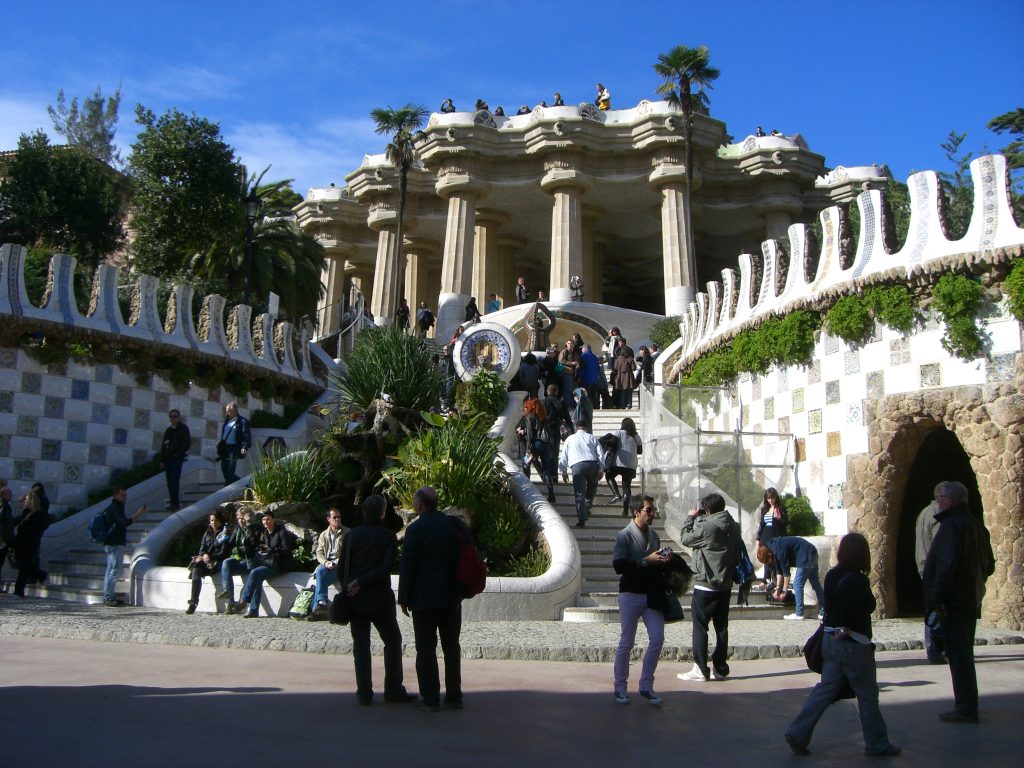

Park Güell in Barcelona
Main entrance of the Park Güell in Barcelona

Gaudí dragon fountain in Park Güell
The Gaudi dragon fountain is at the entrance to the Park Güell. This dragon is adorned in beautiful coloured tiling and is one of the most famous images of this park

Terrace of the Park Güell in Barcelona

 Doric columns support the roof of the lower court which forms the central terrace of the Park Güell, with serpentine seating round its edge


Casa Vicens


Casa Vicens designed by Gaudí in Barcelona
Main façade of La Casa Vicens, a modernist building located in El Barri de Gràcia

Casa Vicens is a modernist house designed by Gaudí
Wrought iron railings of La Casa Vicens, one of the first buildings designed by Antoni Gaudí


Casa Vicens in Gràcia district
Colorful look of the façade of La Casa Vicens


Casa Milà


Chimneys of Casa Milà in Barcelona
Chimneys of La Pedrera are the element which impressed me the most of the roof of this fantastic modernist building designed by Gaudí

Chimneys-shaped warriors of Casa Milà
 A closer view of these spectacular chimneys-shaped warriors of La Pedrera


Casa Batlló


Casa Batlló lit at night
Main façade of La Casa Batlló, a beatiful modernist building designed by Gaudí

Inside Casa Batlló in Barcelona
I really liked the warm colors of the floor, doors and windows in the noble floor of La Casa Batlló

Tiles in roof terrace of Casa Batlló
 The roof terrace of La Casa Batlló is dominated by tiles of different colours on one side, and coloured using the trencadís mosaic technique on the side facing inwards towards the roof terrace

Palau Güell


Palau Güell designed by Gaudí
Main facade of El Palau Güell, located near La Rambla de Barcelona

Parabolic arches in Palau Güell
These parabolic arches are the main entrance of the Palau Güell and are a common feature of the Gaudí designs 

Central Hall of Palau Güell in Barcelona
Impressive dome over the central hall of El Palau Güell


Casa Bellesguard


 The height of Casa Bellesguard is enhanced by the conical turret, topped by a four-armed cross which is so characteristic of Antoni Gaudí’s work


Col·legi de les Teresianes


The religious symbology of Col·legi de les Teresianes in Barcelona is completed by the turrets at either end of the building, which are surmounted by a four-armed cross


Casa Calvet


Casa Calvet in Barcelona
Casa Calvet in Barcelona designed by Antoni Gaudí


Pabellons Güell in Pedralbes


Wrought iron dragon at the gate of Güell Pavilions
Wrought iron dragon at the gate of the Güell Pavilions in Pedralbes

Güell Pavilions in Barcelona

The dome of the longeing ring of the Güell Pavilions,  a complex of buildings in the neighborhood of Pedralbes and designed by the catalan modernist architect Antoni Gaudí


Colònia Güell Church


Church of Colònia Güell in Barcelona
Stained glass windows and bell tower of the church, the crypt actually, of La Colònia Güell

Crypt of Colònia Güell in Barcelona
Ceiling of the crypt of La Colònia Güell

El Capricho (located in Comillas, Cantabria)


El Capricho designed by Gaudí
El Capricho, a house built by the brilliant modernist architect Antoni Gaudi, is the most beautiful modernist building in Comillas

El Capricho designed by Gaudí
This combination of spanish and arabic colorful elements give a cheerful look to this building


Cathedral of Mallorca


Baldachin of the cathedral of Palma de Mallorca designed by Gaudí
Baldachin of the gothic cathedral of Palma de Mallorca designed by Antoni Gaudí


The brilliant architect Antoni Gaudí is buried in the crypt of the Sagrada Familia Basilica, his most ambitious masterpiece:


Tomb of Antoni Gaudí in the crypt of the Sagrada Familia Basilica


Clicking on the next links you will find more pictures of the most important buildings designed by Antoni Gaudí:


Besides, other modernist buildings you can visit in Barcelona are:


Finally, clicking on the next link you will find more links to other beautiful places in Barcelona, among them, more fantastic modernist masterpieces you can see along the Modernist Route.

miércoles, 4 de enero de 2012

BARCELONA MONTJUÏC: CAIXAFORUM

CaixaForum, the social and cultural center of the Obra Social "la Caixa", is located in one of the main modernist buildings in Barcelona: the Casaramona textile factory. Located at the foot of the mountain of Montjuïc beside the Magic Fountain and el Pueblo Espanyol, this building is a unique textile factory designed by the architect Puig i Cadafalch, one of the three most representative Catalan architects of modernism together with Domenech i Montaner and Antoni Gaudí.

Casaramona textile factory, built in the early 20th century, is a unique piece of industrial Catalan modernist architecture and it was one of the first buildings built in Montjuïc.


Caixaforum in Barcelona
The modernist building of Casaramona factory in Montjuïc has two towers, which served as water reservoirs for fire protection

Caixaforum in Barcelona
The construction system used was built brick following the traditional Catalan construction system. The shapes achieved with this material, in particular the termination of the facades, the wrought iron elements and a limited use of stone and ceramics (in the towers and in a mosaic with the owner's initials) embellish the final design

Caixaforum in Barcelona
A detail of one of the towers of Casaramona textile factory in Montjuïc


CaixaForum offers a wide range of social, cultural and educational projects. Moreover CaixaForum has become one of the most dynamic cultural spaces in Barcelona in which you can visit for free exhibitions of ancient, modern and contemporary art.


You can find useful information about Caixaforum in the following website:
  • obrasocial.lacaixa.es

Besides I would recommend the following beautiful places in Montjuïc:


Of course you can visit modernist masterpieces in Barcelona designed by Antoni Gaudí like:


Besides, other modernist buildings you can visit in Barcelona are:


Finally, clicking on the next link you will find more beautiful places in Barcelona, among them more nice places to visit in Montjuïc and other fantastic modernist buildings in Barcelona.

martes, 27 de diciembre de 2011

BARCELONA: PEDRALBES GARDENS AND PALACE

Revealing both English and French influences, romantic bridges and verdant green areas, a walk along the gardens of the Pedralbes Royal Palace,  one of the most beautiful parks and gardens in Barcelona will transport you to a time when serenity and majesty were determining elements of the landscape.

When you pass through the magnificent forged-iron entry door, a large space will welcome you. There is an elegant oval pond in the middle with the sculpture of a woman in its centre. In front, flower beds and, behind, a slight slope covered with grass and well-tended bay trees and orange trees, replete with a small waterfall.

Pedralbes gardens in Barcelona
The pond at the Pedralbes gardens entry is presided over by a marble female nude


There are crushed rock footpaths on both sides of the pond, which are interwoven throughout the entire park so that you can get lost and meander along them. It doesn't matter if you select the left-hand path or the right-hand one, they will lead you to a central passage where the lime trees play a leading role. This is a shady space, like the areas flanked by benches on both sides of the path, with dense and exuberant vegetation.


Pedralbes palace in Barcelona
If you continue up the path, the shady lanes will take you to the Royal Palace, located at the back of the park. The path opens up onto a semicircular square in front of the palace, surrounded on both sides by a large balustrade decorated with busts sculpted from white marble. Since the railing is located under the shade of the trees, this is a perfect place to sit for a moment and gaze upon the building

Pedralbes palace in Barcelona
The semicircular square is sunny and presided over by a white marble sculpture of Isabel II holding her son Alfons XII in her arms and a pond in the middle surrounded by flowerpots filled with geraniums

Pedralbes palace in Barcelona
The palace is the fruit of the modification of the Güell tower to become the residence of the royal family. The ancient tower comprises the central body of the building and new rooms were built to both sides of it

Pedralbes gardens in Barcelona
The balustrade in front of the building is decorated with white marble busts

Pedralbes gardens in Barcelona
There are many unique elements throughout the park, which you will discover as you walk along the crushed stone footpaths that cross the park in all directions, always surrounded by splendid vegetation, sometimes wooded, always shady and fresh, with birdsong filling the air


Parabolic pérgola in Pedralbes gardens
Your meandering will take you to two works by Antoni Gaudí: a parabolic pérgola covered with climbing plants -indeed, a shade-filled paradise- and, in a small corner, the fountain of Hercules, with the water bubbling up from a forged-iron dragon's head

Fountain of Hercules in Pedralbes park
In the small bamboo forest, there is a fountain of Hercules created from wrought iron and stone. The work is by Antoni Gaudí (1884). The dragon head is a spout from which the water bubbles and under is a stone spout with four bars on its front. There is a bench carved from stone on both sides and a marble bust on the pedestal from which the dragon head emerges

Pedralbes park
Another nice image of the Pedralbes gardens in Barcelona

Flags near Pedralbes Gardens
Flags near in Avinguda Diagonal near the main entrace of El Palau de Pedralbes


Of course, you can visit more fantastic parks in Barcelona like:


Finally, clicking on the next link you will find links to other beautiful places in Barcelona, among them, more nice places in Pedralbes like the Pedralbes Monastery or La Finca Güell and more beautiful parks and gardens in Barcelona.


sábado, 24 de diciembre de 2011

BARCELONA MODERNISM: MERCAT DE LA BOQUERIA


La Rambla’s history is the Boqueria Market’s history. The evolution from a past of peddlers to a modern and charming present, full of colour and life. The market is a metaphor for Barcelona’s life, a human river that is the delight for those who like watching.


Mercat de la Boqueria in Barcelona
El Mercat de la Boqueria is a space full of life, history and unquestionable architectural value and one of the largest markets in Barcelona


The first of Barcelona’s local markets was opened on Saint Joseph’s day, on the 19th of March 1840, after four years of work on the land that was up until then occupied by Saint Joseph’s convent. However, the history goes back a good few years before, because on the site on Rambla where the market is today, there were already peddlers selling meat in the thirteenth century.

Mercat de la Boqueria in Barcelona
A modernist detail close to the main entrance of El Mercat de la Boqueria


Marquis Campo Sagrado, Catalonia’s general captain, started to establish the rules for this travelling market in an area that became a large square after the convent was gone. With time the Boqueria Market of Barcelona transformed itself in a modern market. It incorporated the gas illumination and the metal cover was finished in 1914. This metal cover as well as protecting food, sellers and buyers, gives character to the market.


Mercat de la Boqueria in Barcelona
Nowadays, sellers proudly show the oldest and most complete food market of Barcelona

Mercat de la Boqueria in Barcelona
Sellers in El Mercat de la Boqueria offer us vegetables, meat, fish and thousands of other products in stalls with great charm and imaginative presentation

Mercat de la Boqueria in Barcelona
All kind of vegetables and fruit gives a really colourful look to El Mercat de la Boqueria


I also would like to give you some useful information about El Mercat de la Boqueria:

  • Address: La Rambla, 89 bis - Plaça de la Boqueria.
  • Phone: 933 182 584 / 933 182 017.
  • How to get there: Metro L3, stop Liceu. Bus 14, 59 and 91.
  • Web site: www.boqueria.info.
  • Opening time: Monday to Saturday, from 8am to 8.30pm.
Finally, clicking on the next link you will find links to other beautiful places in Barcelona, among them, more Modernist nice buildings along the Modernism Route.


viernes, 23 de diciembre de 2011

BARCELONA - MODERNISM OF GAUDI: CASA BATLLO

Recently I visited La Casa Batlló and I liked a lot what I saw. Moving through the house, I was constantly surprised by the details I discovered with every step: curved line, parabolic arches, colourful stained-glass windows, raised ceramic tiles, decorative pieces of masonry or the shapes of the door handles and banisters ergonomically designed.

Antoni Gaudí gave Casa Batlló a facade that is original, fantastical and full of imagination. He replaced the original facade with a new composition of stone and glass. He ordered the external walls to be redesigned to give them a wavy shape.

La Casa Batlló is one of the most beautiful buildings in Barcelona, a jewel of modernism designed by the brilliant architect Antoni Gaudí. It is the definitive work of art, with the artist encouraging everything to work together: design, space, colour, shape and light.

La Casa Batlló consists of a ground floor, a main floor with a courtyard, four further self-contained floors, a loft and a roof terrace. Next you can see some pictures of these parts I took during this visit.


Main Facade

Balconies of Casa Batlló in Barcelona
I wonder if the Balconies of Casa Batlló are masks or maybe bats

Noble Floor of Casa Batlló
On the Noble Floor of Casa Batlló, Antoni Gaudí included a huge gallery - to see and be seen - which projects several metres out over Passeig de Gràcia. He also inserted stone columns in the shape of bones


Noble Floor

Mushroom-shaped fireplace in Casa Batlló
Romantic mushroom-shaped fireplace, which is flanked by a bench on either side, one for the chaperone and the other for the couple being chaperoned

Noble floor of Casa Batlló
I really liked the warm colors of the floor and doors and windows in the noble floor of Casa Batlló

Noble floor of Casa Batlló
The ceiling is wavy, in allusion to the sea. It features an ingenious whirlpool effect which evokes the power of the sea

Inner courtyard of Casa Batlló
The inner courtyard of Casa Batlló is decorated with more than 15,000 glazed tiles

Blue tiles in Casa Batlló
There are five different tones of blue tiles used in the well of Casa Batlló, inspired by the different shades of the sea

Landing in Casa Batlló
Spacious landing with direct views towards the blue tiling of the building well. The windows in Casa Batlló, like the one of this picture, play a double role: the upper part being for illumination and the lower part for ventilation

Loft

Parabolic arches in Casa Batlló
There are more than 60 parabolic arches in the loft area of Casa Batlló

Roof Terrace

Roof terrace of Casa Batlló
The building is crowned with a spectacular roof which, being composed of large scales, looks like a dragon's back

Roof terrace of Casa Batlló
The roof terrace of La Casa Batlló is dominated by what is affectionately known as the dragon’s back. Gaudí represents an animal’s spine using tiles of different colours on one side, and coloured using the trencadís mosaic technique on the side facing inwards towards the roof terrace

Chimneys of Casa Batlló
The roof of La Casa Batlló is decorated with four chimney stacks like the one of this picture – sinuous, stylised and polychromatic, in an endless flirtation with the heavens. Behind the aesthetic aspect, functionality is ever-present: the wind cannot obstruct smoke from escaping thanks to the chimney caps on the tops of the chimneys, which are tiled with the same trencadís glazed mosaics as the facade

Tower and cross which crowns Casa Batlló
As you can see, La Casa Batlló also has a tower, and rising from this is a cross with four arms pointing north, south, east and west

Cross which crowns Casa Batlló
A closer view of the cross which crowns Casa Batlló. This cross shows the religiosity of Antoni Gaudí

Casa Batlló lit at night
A last picture of the facade of Casa Batlló, which is tiled with a mosaic composed of pieces of glass and ceramic discs, giving an undulating surface


Of course you can visit more wonderful modernist masterpieces in Barcelona designed by Antoni Gaudí like:


Besides, other modernist buildings you can visit in Barcelona are:


Finally, clicking on the next link you will find links to other beautiful places in Barcelona, among them, more fantastic modernist buildings along the Modernism Route.

martes, 20 de diciembre de 2011

CATALONIA: DELTA DEL EBRE LANDSCAPES

Delta del Ebre in Costa Daurada is a really beautiful environment in Catalonia and I really enjoyed the days I spent there. So I would like to show you more pictures of these fantastic landscapes (you can see other ones clicking on the previous link).

Some of the landscapes of Delta del Ebre I liked the most were:
  • Badia dels Alfacs
  • Barra del Trabucador
  • Llacuna de la Tancada
  • Arrossars
  • Llacuna de l'Encanyissada
and next some of the pictures I took of these sceneries:


Delta del Ebre in Catalonia
Water of Badia dels Alfacs in Delta del Ebre is really quiet

Badia dels Alfacs in Delta del Ebre
Sant Carles de la Ràpita appears behind Badia dels Alfacs,viewed from La Barra del Trabucador, one of the most beautiful places in Delta del Ebre

Barra del Trabucador in Delta de l'Ebre
Road along La Barra del Trabucador in Delta de l'Ebre

Llacuna de la Tancada in Delta de l'Ebre
Flamingos in Llacuna de la Tancada, one of the largest ones in Delta de l'Ebre

Llacuna de la Tancada in Delta de l'Ebre
Taking pictures of Flamingos from a viewpoint beside Llacuna de la Tancada in Delta de l'Ebre

Llacuna de la Tancada in Delta de l'Ebre
Another picture of the flamingos in La Llacuna de la Tancada

This picture of a flamingo is actually a picture of a picture

Llacuna de la Tancada in Delta de l'Ebre
From this viewpoint beside La Llacuna de la Tancada I took the previous pictures of this lagoon

Llacuna de l'Encanyissada in Delta de l'Ebre
More flamingos in La Llacuna de l'Encanyissada, the largest lagoon in Delta de l'Ebre

Rice fields in Delta de l'Ebre
Typical landscape of El Delta de l'Ebre: arrossars (rice fields)

Viewpoint in Delta de l'Ebre
Viewpoint beside La Llacuna de l'Encanyissada and La Casa de Fusta in Delta de l'Ebre

Llacuna de l'Encanyissada in Delta de l'Ebre
We rent binoculars to watch better the flamingos in La Llacuna de l'Encanyissada

Rice field in Delta de l'Ebre
Another rice field in Delta de l'Ebre beside La Llacuna de l'Encanyissada


Of course, El Delta del Ebre is not the only interesting place to visit along La Costa Daurada. This 216 km of Mediterranean coastline offers very interesting tourist attractions such as:

Finally, clicking on the next link you will find links to other beautiful places in Catalonia, among them, more interesting medieval villages.