Mostrando entradas con la etiqueta Barcelona - Montjuïc. Mostrar todas las entradas

lunes, 29 de junio de 2015

BARCELONA: MONTJUIC MAGIC FOUNTAIN


The Magic Fountain in Montjuïc is one of the most impressive shows you can see in Barcelona. So I would like to show you some pictures of this impressive fountain and its nice environment in Montjuïc.


Venetian towers and Catalonia National Palace in MontjuïcMaria Cristina avenue links Venetian towers in Plaça d'Espanya to the Montjuïc Magic Fountain and the Catalonia National Palace


Museu Nacional d'Art de Catalunya in Montjuïc

Building of the Museu Nacional d'Art de Catalunya (MNAC) in Montjuïc


Museu Nacional d'Art de Catalunya in Montjuïc
A closer view of the previous building from which you can enjoy fantastic views of Barcelona


Montjuïc viewpoint in Barcelona
In the background of this picture, taken in front of the MNAC, the two towers of the Olympic Village can be see


Barcelona from Montjuic
 Collserola Tower and the Sacred Coeur Church on the Tibidabo hill  from Montjuïc


Tibidabo and Magic Fountain from Montjuïc
Before 2010 the view of Barcelona was this one without the four colums representing the flag of Catalonia ("La Senyera")


Sagrada Familia from Montjuïc in Barcelona
From the same point, a view of Barcelona where La Sagrada Familia appears in the background on the left


Barcelona from Montjuic
Sagrada Familia on the left and Agbar Tower on the right from Montjuïc


Magic Fountain in Montjuic
In summer you can see the performance of the Magic Fountain in Montjuïc everyday from 9pm.


Magic Fountain in Montjuic
In summer a lot of people enjoy the performances of the Magic Fountain everyday


Magic Fountain in Barcelona
I like a lot the colored water jets to the rhythm of music of the Magic Fountain in Montjuïc


Magic Fountain in Barcelona
A closer view of the Magic Fountain in Montjuïc, one of the best attractions in Barcelona


And now more pictures of the Magic Fountain in Barcelona lit at night:


Montjuïc Magic Fountain lit at night in Barcelona
The Montjuïc Magic Fountain in a really colorful moment in a summer evening in Barcelona


Montjuïc Magic Fountain in Barcelona
High water jets from the Montjuïc Magic Fountain in Barcelona


Montjuïc Magic Fountain lit at night in Barcelona
Another picture of this Magic Fountain, which amazes everyone who looks at it


Magical Fountain Useful Information

- How to arrive:
  • Metro L1 i L3, Plaça Espanya Stop
  • Bus 9, 13, 27, 30, 37, 50, 55, 56, 57, 65, 79, 109, 157 and 165
  • FGC parada Plaça Espanya
  • Barcelona Bus Turístic, CaixaForum-Pavelló Mies van der Rohe Stop
- Web: www.bcn.es/fonts


Besides I would recommend the following beautiful places in Montjuïc:


Finally, clicking on the next link you will find links to more beautiful and interesting places of Barcelona, among them, more nice places in Montjuïc.


domingo, 3 de mayo de 2015

BARCELONA: POBLE ESPANYOL


The Poble Espanyol was built in 1929 for the Barcelona International Exhibition as the pavilion dedicated to art. Right from the start, it was conceived as a real “village” in the heart of a city. The aim was to give an idea of what might be an “ideal model” of an Iberian village that would bring together all the characteristics of all peninsular villages.

It was built in thirteen months and, curiously, had an expiry date, as it was supposed to last the same time as the Universal Exhibition: six months. However, thanks to its success, the Poble Espanyol still stands to this day.


Map of Poble Espanyol in Barcelona
Map of The Poble Espanyol in Barcelona beside the mountain of Montjuïc


So The Poble Espanyol is nowadays an open air architectural museum in Barcelona, just a few meters away from the Magical Fountain of Montjuïc. It is one of the biggest attractions of the city in a quiet and peaceful environment.

This museum is a selection of full-scale replicas of 117 buildings from different parts of the Peninsula, with streets, squares, houses, parks, restaurants and artisan workshops.

Next I would like to show you some pictures of the buildings I liked the most of The Poble Espanyol: 


Walls of Avila in The Poble Espanyol
The walls of Ávila are the entrance gate of The Poble Espanyol in Barcelona. It is made up of two 17-metre high cylindrical towers joined at the top to form a bridge from which the entrance gate was defended


Casa del Sol of Caceres
Casa del Sol (Sol House) in the town of Cáceres, whose old town is World Heritage by UNESCO, near the entrance to The Poble Espanyol in Barcelona


Casa de Encomienda and Casa Consistorial of Teruel
Casa de Encomienda and Casa Consistorial in the town of Teruel beside the Plaza Mayor (Main Square) of The Poble Espanyol in Barcelona


Town hall of Sanguesa in Navarra
Town hall of Sangüesa in Navarra called Las Arcadas because it has four arches


City Hall of Valderrobres in The Poble Espanyol
Ayuntamiento de Valderrobres (City Hall of Valderrobres) beside the Plaza Mayor in The Poble Espanyol


City Hall of Valderrobres in The Poble Espanyol
Ayuntamiento de Valderrobres y Casa de los Moreno (Segovia) in one of the corners of the Plaza Mayor of The Poble Espanyol


Building of Caldas de Reyes in Galicia
Ayuntamiento de Valderrobres and, on the right, a typical building of the village of Caldas de Reyes in Galicia


Gradas de Santiago in The Poble Espanyol
Gradas de Santiago (staircase of the Cathedral of Santiago de Compostela) with the Carmelitas church in Teruel behind


Utebo Tower in The Poble Espanyol
Utebo Tower is a Moorish tower in The Poble Espanyol


Utebo Tower in The Poble Espanyol
This bell tower is one of the best examples of the Aragonese Mudejar style, combined with elements of Gothic architecture


Andalusian White Village in The Poble Espanyol
Plaza Peñaflor (Peñaflor Square) where Calle Cuna begins is typical of an Andalusian White Village


Andalusian White Village in The Poble Espanyol
A whitened house next to an Arab influenced arc that leads up to the street called Calle de Los Arcos in The Poble Espanyol


Andalusian White Village in The Poble Espanyol
It is characteristic of many streets in Andalusia, with whitened houses with large grilles and crossed by arches joining the buildings and forming screens to protect them from the sun


The Romanic Monastery of Sant Miquel is made up of elements from different monasteries of Catalonia. As often happens in such cases, it is located outside the urban centre in a quiet place, surrounded by trees and with a great view of the city of Barcelona.


 Romanesque monastery of Sant Miquel in The Poble Espanyol
Romanesque Monastery of Sant Miquel in The Poble Espanyol you can visit in Montjuïc


Monastery of Sant Miquel in The Poble Espanyol
Romanesque cloister of The Monastery of Sant Miquel in The Poble Espanyol


Monastery of Sant Miquel in The Poble Espanyol
The cloister of The Monastery of Sant Miquel is a replica of the cloister of Sant Benet de Bages, a Benedictine monastery founded in the X century


Caballeros Street in The Poble Espanyol
Caballeros Street leads to the exit of The Poble Espanyol


Casa del Marques de Santillana in The Poble Espanyol
Casa del Marqués de Santillana, en Santillana del Mar, in Caballeros Street of The Poble Espanyol


Caballeros Street in The Poble Espanyol
Caballeros Street near the entrance to the Poble Espanyol in Barcelona


Casa Ramos in Vinuesa
Casa Ramos in Vinuesa, a village of Soria


Poble Espanyol in Barcelona
Ayuntamiento de Graus, a village of Huesca, in Plaza Mayor of The Poble Espanyol


What I like the most of Pueblo Espanyol is that is an open-air museum and is quite pleasant to visit it on a sunny day. It also gives an idea of some typical elements of Spanish villages: walls, palaces, arcaded squares, Moorish churches, Romanesque monasteries or houses and streets of the Andalusian White Villages.


Next you have links of some of the most beautiful places of Barcelona. Most of them are located in four areas: Modernism RouteGothic Quarter (and Old City), Montjuïc and Barcelona Seafront. Cliking on the links below you will get more and information and pictures.

- Modernism Route


- Born, Gothic Quarter and Old City


- Montjuïc


- Barcelona Marina and Beach


- Outside the city centre


- Other museums in Catalonia:

domingo, 26 de enero de 2014

BARCELONA - MONTJUIC: REFUGI 307

Refugi 307 is one of the bomb shelters which were built during the Civil War to protect the population from the indiscriminate bombing to which Barcelona was subjected. The first shelters were set up in the basements of houses and in metro stations. However, as the bombings intensified, people joined together to build air-raid shelters.

More than a thousand were built during the war, and among them was Refugi 307, (shelter number 307). This refuge consists of 400 metres of tunnel measuring 1.6 meters wide and 2 meters high. During the visit, you can discover what the living conditions were like within its walls and see the different rooms, including the toilets, a drinking fountain and an infirmary.


Refugi 307 in Barcelona


Refugi 307 in Barcelona
Refugi 307 in Barcelona was built under the mountain of Montjuïc


Refugi 307 in Barcelona
Open air Exhibition inside the Refugi 307 in Barcelona


Barcelona during the Civil War
Bombardment of Barcelona during the Civil War


Occupation of Barcelona during the Spanish Civil war
Occupation of Barcelona during the Spanish Civil war in 1939


Plan for Refugi 307 in Barcelona


Refugi 307 in Barcelona
Latrines inside Refugi 307 in Barcelona


Tunnels of Refugi 307 in Barcelona


Tunnels of Refugi 307 in Barcelona
Refugi 307 consists of 400 meters of tunnels 


Tunnels of Refugi 307 in Barcelona
Throughout the length of the shelter, you can get a glimpse of living conditions in its tunnels


- Useful information:

  • Address: Nou de la Rambla, 169
  • How to get there:
    • Metro: L2 and L3 stop Paral.lel.
    • Bus: 20, 21, 36, 57, 64 and 157
  • Web site: www.museuhistoria.bcn.cat


viernes, 21 de diciembre de 2012

SHOPPING IN BARCELONA: LAS ARENAS MALL

After having talked about El Portal de l'Angel, one of the main shopping streets in Barcelona together with El Passeig de Gràcia and La Diagonal, today I would like to speak about a new shopping center in Barcelona: Las Arenas.

Located next to La Plaça de Espanya and near the Montjuïc Magic Fountain, it opened its doors on 25th march 2011. From that day, many people go to Las Arenas, which was a bullring, for shopping or to enjoy the views of Montjuïc from the dome.

However, as well as shopping, inside the six floors of Las Arenas you can go to the twelve-screen cinema, you can exercise in the fitness center, visit the Museum of Rock or have dinner in one of the many restaurants. If you prefer to eat near the city center, in a previous post I recommended some great restaurants.

I went to Las Arenas on 30th april and the next pictures show what I liked the most of this bullring converted into a shopping center.

Las Arenas Shopping Mall


Las Arenas shopping center in BarcelonaLas Arenas shopping center, located near Montjuïc, one of the most beautiful areas in Barcelona

Las Arenas Shopping MallOverview of Las Arenas Shopping Mall where you can see the dome, the terrace and the Neomudejar facade


Views from the dome of Las Arenas


View from the dome of Las Arenas shopping mall
Behind La Plaça d'Espanya, you can see Maria Cristina Avenue with the Venetian Towers and the Magical Fountain of Montjuïc at the end


Joan Miro park from the dome of Las Arenas shopping mallView of Joan Miro Park located next to Las Arenas


Neomudejar windows of Las Arenas shopping mallNeomudejar windows give an arab look to the facade of Las Arenas


Inside Las Arenas Shopping Mall


Inside Las Arenas shopping mallFrom the platform in the middle of Las Arenas shopping center this is what I saw


Inside Las Arenas shopping mallSome of the 115 shops inside Las Arenas shopping center


Las Arenas Shopping Mall lit at night


Neomudejar facade of Las Arenas shopping mall
The Neomudejar facade of Las Arenas shopping mall lit in the evening


Las Arenas shopping center
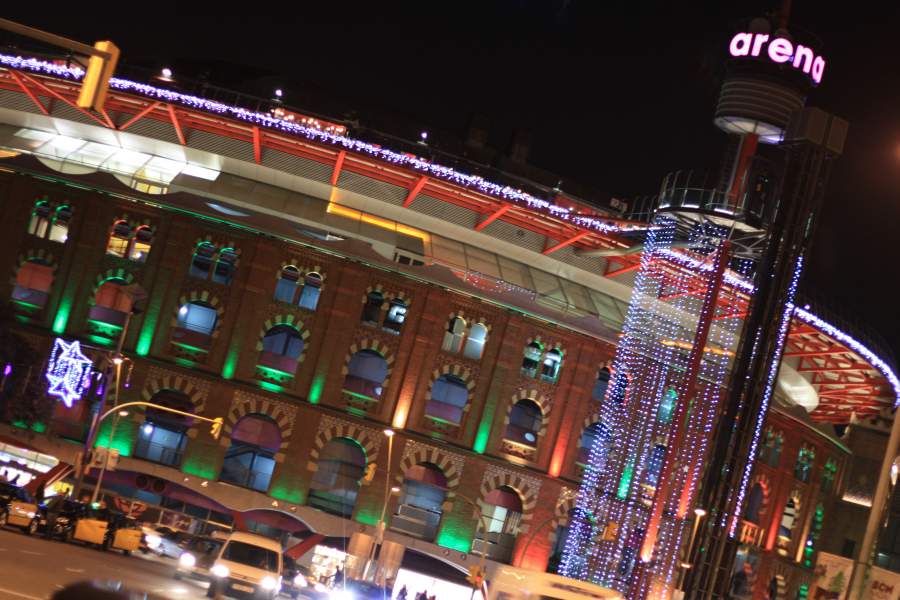
Las Arenas shopping mall lit at night


Las Arenas shopping mall lit at night
Las Arenas shopping center has become one of the most spectacular ones of Barcelona


Las Arenas shopping mall
Detail of Las Arenas shopping mall decorated with Christmas details

I also would like to give you some useful information about Las Arenas:

- Address: Gran Via de les Corts Catalanes núm,373-385.
- How to arrive:
  • Metro: L1 and L3, stop Plaça Espanya.
  • Bus: 9, 13, 27, 30, 50, 56, 57, 65, 79, 91, 109 and 157.
- Opening time:
  • Shops: from 10:00 to 22:00 (Monday to Saturday).
  • Restaurants: From 10:00 to 00:30 (Monday to Thursday), from 10:00 to 02:30 (Friday, Saturday and eve of public holidays), from 10:00 to 01:30 (Sundays).
- Website: http://www.arenasdebarcelona.com/

 Other shopping areas in Barcelona are:


Finally, clicking on the next link you will find links to other beautiful places in Barcelona, among them, more nice places in Montjuïc.