miércoles, 29 de octubre de 2014

BELGIUM: BRUSSELS, GHENT AND BRUGES

In late October we spent four days in Belgium visiting Brussels, Ghent and Bruges. When I was 17 years old I did a trip to Paris - Bruges - Amsterdam with the High School and I remember Bruges with special affection, though vaguely. This is why I wanted to come back to this town and visit Ghent too, of which I had heard very well, and Brussels.

We tried to visit Antwerp too, but we realized that we had not enough time. In late October the days are quite short. So we decided to visit quietly only these three cities, enjoying their charm. Even at the end we wished we could have one more day to see Brussels more quietly.

We spent the first and last days in Brussels for convenience and logistics. We spent the two complete days in Ghent and Bruges. Fortunately, the weather forecast for both days was very good. Otherwise we had visited Bruges the day with better weather forecast.
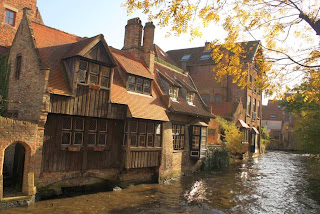


Bruges in Belgium
Bruges in Belgium


There is a 50% discount on train tickets on weekends, so we went on Friday to Ghent and on saturday to Bruges because Bruges is furthest away and the train ticket is more expensive. By visiting only two cities the Rail Pass was more expensive than taking advantage of the discount weekend.


Below you can see the planning we followed in this trip:


  • Day 1 - Brussels
  • Day 2 - Ghent
  • Day 3 - Bruges
  • Day 4 - Brussels


  • Day 1 - Brussels


    • Manneken Pis
    • Grand Place
    • Jeanneken Pis
    • Royal Palace

    Day 2 - Ghent


    • Korenmarkt
    • St. Niklaaskerk
    • Belfort
    • Mammeloker
    • St. Baafskathedraal
    • Duivelsteen
    • Stad Huis (city hall)
    • Gravensteen
    • Korenlei and Graslei
    • Appelbrugparkje Bridge
    • St. Michielskerk and St. Michielsplein


    Day 3 - Bruges


    • Canals of Bruges
    • Minnewater Park and Swan Lake
    • Hospital of Saint John
    • Onze-Lieve-Vrouwekerk (Church of our Lady)
    • The most beautiful place in Bruges
    • RozenHoedKaai in Bruges
    • The most photographied place in Bruges
    • Burg Square
    • Markt Square
    • Belfort Tower


    Day 4 - Brussels


    • Atomium
    • Laeken Park: Japanese Tower and Chinese Pavilion
    • Parc du Cinquantenaire
    • European Parliament
    • Grand Place


    Brussels (Bruxelles, Brussel)


    Manneken Pis in Brussels
    Manneken Pis in Brussels


    City Hall of Brussels
    City Hall of Brussels


    Maison du Roi and Grand Place in Brussels
    Maison du Roi and Grand Place in Brussels


    Grand Place in Brussels
    Colourful flowers on the Grand Place in Brussels


    Brussels in Belgium
    One of the streets around the Grand Place in Brussels


    Jeanneken Pis in Brussels
    Jeanneken Pis in Brussels


    Royal Palace in Brussels
    Royal Palace in Brussels 


    Ghent (Gand, Genk)


    Korenmarkt in Ghent
    Korenmarkt in Ghent


    St Niklaaskerk in Ghent
    Sint Niklaaskerk in Ghent


    St Niklaaskerk in Ghent
    Apse of the gothic church of Sint Niklaaskerk


    Belfort Tower in Ghent
    Belfort Tower in Ghent


    Sint Baafskathedraal in Ghent
    Sint Baafskathedraal in Ghent


    Geeraard de Duivelsteen in Ghent
    Geeraard de Duivelsteen in Ghent


    Gravensteen in Ghent
    Gravensteen in Ghent


    Kraanlei in Ghent
    Kraanlei in Ghent


    Graslei in Ghent
    Graslei in Ghent


    The three towers of Ghent from Sint Michielshelling bridge
    The three towers of Ghent from Sint Michielshelling bridge


    Sint Niklaaskerk in Ghent from Sint Michielshelling bridge
    Church of Sint Niklaaskerk in Ghent from Sint Michielshelling bridge


    Bruges (Bruges, Brugge)


    Canal in Bruges
    Our first image of the canals of Bruges shortly after leaving the train station


    Bruges in Belgium
    Beside this canal we walked along a promenade among trees. A beautiful place between the train station and the town of Bruges


    Minnewater park in Bruges
    Swans in Minnewater park in Bruges


    Onze-Lieve-Vrouwekerk in Bruges
    Onze-Lieve-Vrouwekerk (Church of our Lady) in Bruges


    Canal in Bruges
    Beautiful place beside the apse of the church of our lady in Bruges


    RozenHoedKaai in Bruges
    RozenHoedKaai in Bruges


    Belfort tower in Bruges
    The most photographied place in Bruges


    Burg square in Bruges
    City Hall of Bruges in Burg square


    Markt square in Bruges
    Colourful houses in Markt square in Bruges


    Markt square in Bruges
    Markt square in Bruges


    Belfort tower from Markt in Bruges
    Belfort tower from Markt in Bruges


    Brussels


    Atomium in Brussels
    Atomium in Brussels


    Japanese Tower in Brussels
    Japanese Tower in Brussels


    Chinese Pavilion in Brussels
    Chinese Pavilion in Laeken Park in Brussels


    Chinese Pavilion in Brussels
    Detail of the chinese pavilion in Laeken Park in Brussels


    Parc du Cinquantenaire in Brussels
    Parc du Cinquantenaire in Brussels


    European Parliament in Brussels
    European Parliament beside Leopold Park in Brussels


    Grand Place in Brussels
    We went to the Grand Place because we wanted to finish our trip there enjoying a delicious waffle


    Grand Place in Brussels
    Maison du Roi beside the Grand Place in Brussels


    - Unfortunately we didn't have enough time to visit the following places in Brussels:


    • Comic route
    • Zinneke Pis
    • Les Marolles
    • Bar À la mort subite 


    - Typical dishes we tried in Belgium:


    • Waffles: with strawberries, or with banana or with white sugar
    • Cone of fries with andalousian sauce
    • Prawn croquettes
    • Marinated mussels
    • Soups (Potages du jour): All the soups I tried were delicious


    - Train and metro:


    • 50% discount on train tickets on weekends.
    • Bruges 14€ Ghent 8,5€, so: 8,5x4 + 0,5x14x4= 62€ for two people.
    • Rail Pass: 76€.
    • Metro :

      • 10 tickets card:14€
      • 24h card (one person): 7€


    • Airport: Train ticket 8,5€. 15-20 minutes from Gare Centrale to Zaventem Airport.
    • Ghent: Train from Brussels + tramway from train station to the old town.
    • Bruges: Train from Brussels + 15 minutes walk.


    - Hotel


    • Adagio Access Bruxelles Europe Aparthotel:


      • Address: Rue de l'Industrie, 12 (metro Trône or Arts Loi).
      • Quite well but 15 minutes far from the old town.
      • Metro: Trône or Arts-Loi (5 minutes walk).


    - Restaurants and bars:
    • Restaurant Chez Leon (near Jeanneke Pis)
    • Bar Delirium Tremens (near Jeanneke Pis)
    • Waffles: Near  Manneken pis


    - Websites for planning our trip:
    • Hotel: www.booking.com
    • Trains: www.sncb.com

    - Places to visit and restaurants:
    • lamaletadeglo.blogspot.com.es
    • www.ungatoenmimaleta.com


    Finally, other countries and cities I have already visited are:

    lunes, 20 de octubre de 2014

    BARCELONA: ALBA SYNCHROTRON

    Since I heard about particle accelerators for the first time, like the Large Hadron Collider (LHC) in CERN, I have been interested in learning more about these high technology machines.

    With the construction of the Alba Synchrotron near the city where I live, I even could eventually visit one kind of them: A synchrotron.


    Barcelona Synchrotron Park


    Alba Synchrotron is a part of the Barcelona Synchrotron Park, a complex of electron accelerators to produce synchrotron light, which includes wavelengths from infrared to X-rays. Synchrotron light is a kind of light emitted by electrons or other charged particles of high energy and rotating within a containtment ring.  As the X-rays have a similar wavelength to the distance between atoms, synchrotron light allows the visualization of the atomic structure of matter as well as the study of its properties.


    Barcelona Synchrotron Park
    Barcelona Synchrotron Park


    Alba Synchrotron


    The ALBA Synchrotron is a 3rd generation Synchrotron Light facility, being the newest source in the Mediterranean area,  located in Cerdanyola del Vallès, 15 km from Barcelona city centre. Its characteristics as a third generation source make it comparable to the new facilities found in Germany, Switzerland, France and the United Kingdom.


    Alba Synchrotron in Barcelona
    Alba Synchrotron located near Barcelona


    The ALBA Synchrotron light source is the most important singular scientific facility in the south of Europe. The facility consists in a linear accelerator and a synchrotron which accelerates electrons at near-light speed, at an energy of 3 GeV. 


    Alba Synchrotron in Barcelona
    Inside the Alba Synchrotron facility


    Generating Synchrotron Light


    The procedure for generating synchrotron light is:

    1- A source generates an electron beam as thin as a hair, and the beam is accelerated through a linear accelerator (also known as LINAC by its acronym in English). The electrons almost reach the speed of light and a first energy level, 100MeV.

    2- The electron beam is directed to a second circular accelerator, called booster, that increases its energy to the level operation of the synchrotron, 3 GeV. The low-emittance, full-energy Booster is placed in the same tunnel as the Storage Ring.

    The RadioFrequency (RF) systems of ALBA are responsible of the electrons acceleration in the Booster and the Storage Ring. In the Booster, the energy of the electrons is increased from 100MeV to 3GeV. In the Storage Ring, the RF systems just restore the energy that the electrons lose due to synchrotron radiation (1.3MeV/turn maximum).


    Radiofrequency system of Alba Synchrotron
    The acceleration is accomplished creating high electric fields in the path of the electrons. The electric fields are created in resonant cavities which are fed by RF Amplifiers.


    3- Electrons are injected into a storage ring of 270 meters where revolve for several hours and emit synchrotron radiation, which is used at the beamlines. This storage ring is optimised to produce a continuum of wavelengths of electromagnetic radiation, from infrareds to X rays. They are stored and maintained within the ring using magnetic fields.


    Alba Synchrotron in Barcelona
    The booster and the storage ring are located inside this structure


    Booster and storage ring of Alba Synchrotron
    Booster and storage ring of Alba Synchrotron


    4- When the electrons moving around in the ring take a curve, they emit extremely intense light with wavelengths ranging from the visible to X-rays. This light is highly focalized, polarized and then emitted in the form of pulses like a camera flash. So using electromagnetic devices the trajectory of the electrons are deflected or forced to oscillate. Electrons lose energy as light, thus generating synchrotron light.

    5- The energy lost by electrons in the form of synchrotron radiation (those beams of light) is compensated by RF cavities giving them energy to keep spinning and the process is repeated.

    6- The synchrotron light is focused and selected (selection of the wavelength) by optical devices (lenses and mirrors) that guide it towards the experimental stations.

    7- Each beamline is a real laboratory to prepare and analyze samples, analyzing the information obtained and thus study the most varied problems: from masterpieces of Renaissance art to chronic degenerative diseases.


    Basic Physical Principle of Operation


    The ALBA accelerators rely on electromagnets to guide and focus the electrons along the trajectory under the influence of magnetic fields, electrons follow the Lorentz force:


    At ALBA four different types of magnets are in use:

    • Dipole magnets: these are typical construction electromagnets with an iron yoke, in a C-form or H-from and two coils wound around the yoke. Dipole magnets are used to deflect the electrons in the transfer lines and also to provide orbit correction.


    Dipole of Alba Synchrotron in Barcelona
    The red magnet is a dipole

    • Quadrupole magnets: as the name indicates, these have four magnetic poles and therefore 4 coils. The magnetic field created by a quadrupole increases linearly with the distance from the center. Quadrupoles are used to focus the electrons and enable the transport of an electron beam over long distances, like for example, an electron beam circulating inside the ALBA storage ring.

    Quadrupole of Alba Synchrotron in Barcelona
    On the left a sextupole magnet and, on the right, a quadrupole magnet


    • Combined function magnets: are a combination of a dipole magnet and a quadrupole magnet. They are used both in the booster and in the storage ring and fulfil two functions at the same time: on one side, they are responsible for the electrons completing the 360º of circumference around both circular accelerators, and on the other side, they provide additional focusing. By the use of combined magnets, space has been saved inside the accelerators. This space has been used to increase the length available to insertion devices.

    Magnets of Alba Synchrotron in Barcelona
    A dipole magnet (red), a sextupole magnet (yellow) and a quadrupole magnet


    • Sextupole magnets: have six poles as its name indicates and are used to provide additional focusing. The magnetic field increases quadratically with the distance from the center.

    Sextupole magnet of Alba Synchrotron in Barcelona
    Sextupole magnet of Alba Synchrotron


    Beamlines


    ALBA's 270 meter perimeter has 17 straight sections all of which are available for the installation of insertion devices.

    ALBA currently has seven operational state-of-the-art phase-I beamlines, comprising soft and hard X-rays, which are devoted mainly to biosciences, condensed matter (magnetic and electronic properties, nanoscience) and materials science. Additionally, two phase-II beamlines are in construction (infrared microspectroscopy and low-energy ultra-high-resolution angular photoemission for complex materials).

    During operation of the beamlines, the accelerators run 24 hours a day, 7 seven days a week. About 75% of the time that the accelerators are powered up is dedicated to providing beam to the beamlines. The rest is dedicated to improving the quality of the beam as well as the further development of the accelerators.


    Beamline of Alba Synchrotron in Barcelona
    One of the operational beamline of Alba Synchrotron


    Beamline of Alba Synchrotron in Barcelona
    High technology equipment in a beamline of Alba Synchrotron


    Applications of Alba Synchrotron


    • BIOLOGY AND BIOMEDICINE to improve the diagnosis and treatment of certain diseases and develop drugs.
    • NANOTECHNOLOGY to study and build electronic and magnetic devices to the nanometer scale.
    • MATERIALS SCIENCE to create more durable materials, corrosion-resistant, lightweight, elastic.
    • ENVIRONMENT to analyze toxic materials of, soil, rocks.
    • PHYSICS to determine the atomic structure of liquids and solids.
    • CHEMISTRY: to analyze and improve the efficiency of chemical reactions.
    • HISTORICAL AND ARTISTIC HERITAGE To study art or archaeological objects noninvasively.


    Alba Synchrotron in Catalonia
    One last picture before leaving the Alba Synchrotron after a really interesting visit